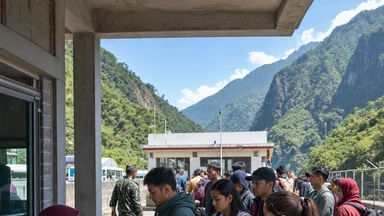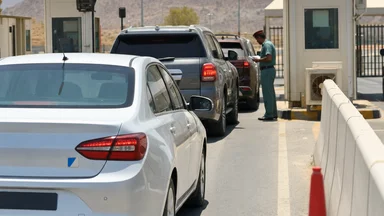
A bus from Kathmandu arrives at the Sindhupalchok checkpoint in Bahrabise, a single-story concrete building with a faded sign. Inside, a queue of about twenty travelers snakes toward a counter where an official slowly examines each passport, compares the photo to the person, and then flips through a ledger to record the entry. The average wait, according to the 2023 Border Efficiency Report by the Swiss NGO Helvetas, is four hours. Locals cross in twenty minutes. The difference is paperwork.
The Four-Hour Stare at a Counter in Bahrabise
Land border crossings are Nepal's back door. While Tribhuvan International Airport in Kathmandu handles the majority of air arrivals, overland entry points like Sindhupalchok serve a steady stream of budget travelers, overland truckers, and trekkers heading to the Tibet Autonomous Region. The checkpoint sits in the Sindhupalchok district, roughly a four-hour drive from Kathmandu along the Arniko Highway. It is the primary land route between Nepal and China, though the Friendship Highway on the Tibetan side is often closed due to weather or political reasons.
The paperwork pile-up is the main culprit. Tourists need three documents: a valid visa (obtained in advance or on arrival), a trekking permit if they plan to hike beyond Pokhara or the Everest region, and a Trekkers' Information Management System (TIMS) card. Each document requires separate scrutiny. The visa application form is often handwritten, and a single error—say, a misspelled name or wrong date of birth—can send you back to the end of the line. The trekking permit must match the intended route, and the TIMS card, issued by the Nepal Tourism Board, is supposed to be purchased in advance but can sometimes be obtained at the checkpoint if the office is open.
The Helvetas report, which studied five land borders in South Asia, found that the average processing time for a tourist at Sindhupalchok was 240 minutes, compared to 20 minutes for Nepali nationals and 45 minutes for Indian nationals (who need only a national ID). The gap is not due to inefficiency alone; it reflects a system designed for a different era. The checkpoint lacks digital visa kiosks, so every entry is recorded by hand in a ledger. Officials cross-check names against a printed list of valid visas, a process that can take several minutes per person.
Locals cross in twenty minutes because they carry only a citizenship card or passport that is scanned and returned. Tourists stall at counters because their documents trigger a manual verification cascade: visa validity, permit type, TIMS card number, onward travel proof. If any document is missing or incorrect, the official must consult a supervisor, which adds another 30–60 minutes. The result is a lengthy wait that can feel like bureaucratic limbo.
Why Kathmandu Airport Is Faster Than a Land Border
Tribhuvan International Airport processes roughly 2,000 arrivals daily, most of them tourists. The on-arrival visa kiosks, introduced in 2016, take between 30 and 60 minutes, depending on queue length. Travelers fill out a digital form at a self-service machine, pay the fee by card or cash, and receive a visa sticker immediately. The system is not perfect—machines sometimes run out of paper or crash—but it is far faster than the manual process at land checkpoints.
Land checkpoints lack digital visa systems entirely. There is no e-visa option for overland entry as of 2026, despite repeated announcements from the Department of Immigration that one is coming. Travelers must fill out a paper form, hand over their passport, and wait while the official copies details into a ledger. The infrastructure gap is stark: airports have scanners, printers, and networked databases; land borders have pens, paper, and a single desk.
The difference is partly historical. Nepal's air borders were modernized as part of a tourism push in the 2010s, when arrivals climbed past one million per year. Land borders, which handle a smaller share of tourist traffic, received less investment. The result is that a traveler flying into Kathmandu can clear immigration in under an hour, while the same traveler arriving by bus from Tibet faces a four-hour wait. Some budget travelers choose to fly even for short trips simply to avoid the delay.
There is a trade-off, however. Air entry costs more—a typical flight from Delhi to Kathmandu runs around US$ 150–250, while a bus from the border costs roughly US$ 10–15. For travelers on a tight budget, the four-hour wait is a price worth paying. But the time cost is real, and it can throw off a carefully planned itinerary.
The Three Documents That Trip Up Travelers
The visa application form is the first hurdle. It is available at the checkpoint, but it must be filled out in block capitals with a black pen. Common mistakes include writing the date in the wrong format (Nepal uses YYYY-MM-DD), leaving the father's name field blank (it is required), or failing to list all previous visas for Nepal. Any error can lead to rejection and a request to fill out a new form, which means rejoining the queue.
The trekking permit is required for any route that goes beyond the main tourist hubs of Pokhara, Kathmandu, and Chitwan. Permits are issued by the Department of Immigration and cost roughly US$ 20–30 per person, depending on the region. Travelers often assume that a tourist visa covers all activities, but trekking in restricted areas like the Upper Mustang or Manaslu requires a separate permit. At the checkpoint, officials check the permit against the intended route. If the route is not listed, or if the permit is for a different area, entry may be denied.
The TIMS card is the most commonly overlooked document. Issued by the Nepal Tourism Board, it costs around US$ 20 and is supposed to be purchased before arrival. At the checkpoint, travelers who lack a TIMS card are directed to a small office in Bahrabise town, roughly two kilometers away. The office is open irregular hours—often closed during lunch (12–2 PM) and on weekends. Travelers who arrive without a TIMS card can expect a delay of at least one day while they wait for the office to open.
Another common mistake is choosing the wrong visa category. The tourist visa (15, 30, or 90 days) is for sightseeing and short treks. The trekker visa is for longer, more remote treks. Travelers who plan to do a multi-week trek on a tourist visa may be flagged and asked to upgrade, which involves paying an additional fee and filling out another form. The cash-only policy for visa-on-arrival catches many card users. ATMs in Bahrabise are scarce, and the nearest reliable machine is in Barabise town, a 30-minute walk. Travelers who arrive without crisp US dollar bills (the preferred currency) may need to find a money changer, which adds another 30 minutes.
What Locals Know That Guidebooks Omit
Nepali and Indian nationals cross the border with just a national ID card or passport. They bypass the tourist queue entirely and head to a separate counter that processes them in under five minutes. Third-country nationals, including tourists from Europe, the Americas, and East Asia, must use the main queue. But there are tricks that locals use to speed things up.
First, bring four passport photos, not one. The visa application requires one photo, the trekking permit requires another, the TIMS card requires a third, and the official may ask for a fourth for the ledger. Travelers who bring only one photo must find a photo shop in Bahrabise, which charges around NPR 200 (≈$1.50) and takes 15 minutes. Second, arrive early morning, before the bus convoys from Kathmandu and Kodari arrive. The checkpoint opens at 8 AM, and the first hour is usually quiet. By 10 AM, the queue can stretch to fifty people.
Third, use the official procedure: if you have all documents ready and the tourist counter is backlogged, politely ask the official at the local counter if they can process you. While there is no guarantee, officials sometimes accommodate travelers who are courteous and prepared. This is not rule-bending but a practical courtesy that can cut the wait in half. Fourth, carry exact change in US dollars or Nepali rupees. The visa fee is US$ 30 for a 15-day visa, US$ 50 for 30 days, and US$ 125 for 90 days. Officials rarely have change for large bills. Travelers who pay with a US$ 100 bill may be asked to wait while the official finds change, which can take 10–15 minutes. Carrying smaller bills or the exact amount avoids this delay.
The Cost Gap Between High-Traffic and Overlooked Entry Points
Sindhupalchok is the busiest land entry point for tourists, but it is not the only one. The Kodari border, located further east, is a smaller checkpoint that sees roughly half the traffic. Wait times there average two hours, according to anecdotal reports from overland travelers. The visa fee is the same, but there are fewer services: no TIMS office, no nearby photo shop, and no ATM. Travelers who choose Kodari save time but risk being stranded if they lack a document.
Mahendranagar checkpoint, in the far west near the Indian border, is the quietest. Wait times are typically under one hour, and officials are known to be more relaxed. However, there is no TIMS office within a reasonable distance, and the nearest city with a bank is Dhangadhi, a two-hour drive. Travelers who enter here must have all documents in order before arrival.
Pokhara airport offers no land entry, but it is a popular alternative for travelers flying from Delhi or Varanasi. Direct flights from Delhi to Pokhara cost around US$ 100–150 and take 90 minutes, compared to a 12-hour bus ride from Kathmandu to Pokhara after clearing the border. The time savings are significant, but the cost is higher. Overland border fees are identical to air entry—the visa fee is the same—so the choice is between time and money.
For budget travelers, the cost gap is narrow. A bus from Kathmandu to the border costs roughly US$ 10, and the visa fee is US$ 30. A flight from Delhi to Kathmandu costs US$ 150–250, plus the visa fee. The difference is US$ 110–210, which for a traveler on a US$ 50/day budget is two to four days of expenses. The four-hour wait at the border is a trade-off many are willing to make.
What Happens When the Paperwork Is Wrong
Incorrect visa validity is the most common reason for denial. Travelers who overstay their visa—even by a day—are denied entry and sent back to India or China. The bus ride back to the nearest Indian border town, such as Raxaul, takes roughly six hours. Travelers who are denied entry must reapply at the Nepali embassy in their home country, a process that can take weeks.
Missing TIMS card results in a fine of NPR 2,000 (≈US$ 15) and a directive to obtain the card at the nearest office. If the office is closed, the traveler must wait in Bahrabise town until it reopens. Accommodation in Bahrabise is basic—guesthouses charge around US$ 8–12 per night—but the delay can stretch to two days if the office is closed for a holiday. The Nepal Tourism Board lists public holidays on its website, but many travelers do not check before crossing.
Wrong passport photo size is a minor but common issue. The required size is 35 mm × 45 mm, the same as for Indian visas. Travelers who bring photos that are too large or too small are sent to a photo shop two kilometers away. The shop charges NPR 200 and takes 15 minutes, but the walk adds another 30 minutes round trip. The total delay is roughly 45 minutes.
No onward ticket proof is another hurdle. Nepal requires proof of onward travel for all foreign nationals, though enforcement is inconsistent. At the land border, officials sometimes ask to see a flight booking or bus ticket out of Nepal. Travelers who cannot provide one are directed to a counter where they can purchase a bus ticket to Kathmandu. The ticket costs around US$ 10 and takes 10 minutes to buy, but it adds to the wait.
The common outcome of any paperwork error is a one- to two-day delay in Bahrabise town. The town has a few guesthouses, a handful of restaurants serving dal bhat and momos, and a small market. It is not a destination in itself, but it is a place where travelers learn the hard way that paperwork is the real border.
How to Cut the Wait to Under Ninety Minutes
Pre-arranging a licensed guide is the most reliable way to speed up the process. Guides are familiar with the officials and know which documents are needed. They can handle the queue while the traveler waits in a nearby tea shop. The cost is roughly US$ 20–30 for the service, which is less than the cost of a night in Bahrabise if a delay occurs. Several trekking agencies in Kathmandu offer border pickup and clearance services for around US$ 50–80, including transport.
Carrying exact USD cash in crisp bills is essential. Officials prefer US dollars for visa fees, and they rarely accept crumpled or torn bills. Travelers who bring new, unwrinkled notes from a bank avoid the hassle of having their money rejected. The visa fee schedule is published on the Department of Immigration website, so travelers can calculate the exact amount before arrival.
Filling the visa form online and printing it before arrival saves time at the counter. The online form is available on the Department of Immigration website, though it is not always functional. Travelers who complete it in advance can hand it directly to the official, skipping the form-filling queue. The online form also reduces the risk of handwriting errors.
Bringing a copy of the hotel booking and flight itinerary is recommended, though not always required. Officials may ask for proof of accommodation and onward travel, especially for solo travelers or those with no prior travel history in Nepal. Having printed copies avoids the need to pull up emails on a phone, which can be slow if the network is weak. Bahrabise has spotty mobile coverage, so relying on digital documents is risky.
Arriving with a local bus driver who knows the official procedure is the insider tip. Drivers who make the crossing daily know which officials are lenient and which counters have shorter queues. Some drivers will take the traveler's passport and documents to the counter while the traveler waits in the bus. This is not official procedure, but it is common practice. Travelers who tip the driver NPR 200–300 (≈$1.50–2.50) often get through in under 90 minutes.
Practical Steps to Streamline Your Crossing
To minimize delays, follow these steps before arriving at Sindhupalchok: First, check the Nepal Tourism Board website for public holidays and TIMS office hours. Second, obtain all three documents in advance: visa (online or from an embassy), trekking permit (if needed), and TIMS card (online or from the NTB office in Kathmandu). Third, print the visa form, hotel booking, and onward ticket. Fourth, bring four passport photos and exact change in crisp US dollars. Fifth, plan to arrive at the checkpoint before 8 AM or after 2 PM to avoid peak crowds. By taking these steps, you can reduce the wait to under 90 minutes.
Overland travel remains the cheapest option for budget travelers, but the time cost is real. A four-hour wait at the border is not a dealbreaker for most, but it can disrupt a tight itinerary. Travelers who plan an extra half-day for the checkpoint—arriving in Bahrabise the evening before and crossing the next morning—avoid the stress of a rushed crossing. The town is not a highlight of Nepal, but it is a functional place to wait.
Respecting the process is the key. Locals do it every day, and they do not complain because they know the system. Tourists who arrive with all documents, in the correct format, and with a patient attitude will get through eventually. The border is not hostile; it is just slow. And for the traveler who treats the checkpoint as part of the journey—not an obstacle—the wait becomes a story, not a setback.